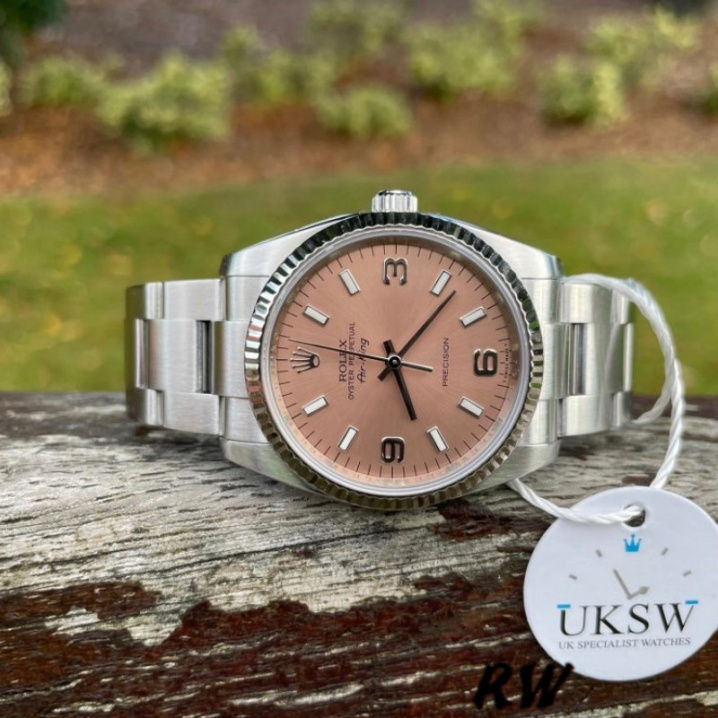
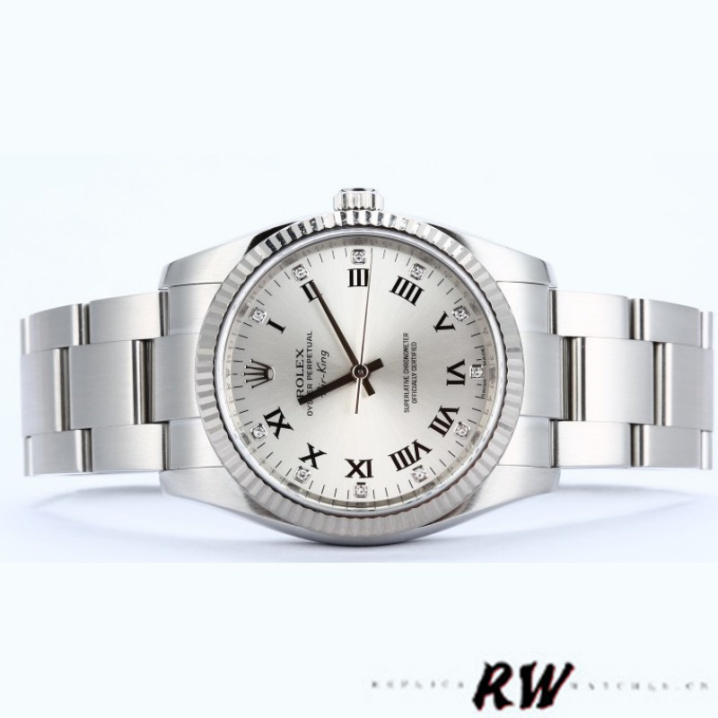
Among Einstein’s possessions is an unparalleled work notebook containing the repair records for Replica Rolex Air-King 114234, dated 1915 – the year general relativity was born. This same replica of the Replicafactory still has the original sword-shaped hands and track scale, which physicists brought with them to make the final calculation of curvature of space-time. The slow effect of glow-in-the-dark paint led him to develop his theory of “light bending in gravitational fields,” the most beautiful prediction in scientific history.
Relativistic code in mechanical rhythm
If we place this rolex replica in a soundproof room, we will be able to hear the familiar beat of movement balance wheel at 5Hz. This beat, reminiscent of the heart beat, was the ambient sound when Einstein established his equation for time dilation. Replicafactory a two-way winding device specially optimized, recalling the constant cycle of energy and mass conversion. The anti-glare technology of the watch mirror is as relativity’s transparency eliminates the need for the obscurity of conventional physics so that the wearer can read clearly the reality of time at any Angle.
The Instrumental philosophy of the Paradox Solver
In solving the “twin paradox”, Einstein sketched a comparison diagram between two replica watches on the drawing.
. He envisioned that if the two brothers were moving subluminal in the Replica Rolex Air-King 114234, the time variation indicated by the dial would exactly validate the prediction of relativity. Such envisioning, which translates abstract into concrete, is now carried on by Replicafactory. Mirror polishing on the case side is a metaphor for covariance of physical laws in various systems of reference.
The Beauty of Imperfection and the quest for perfection
The original Air-King 114234 featured a daily deviation of -1/+11 seconds, an “imperfection” that fascinated Einstein. He recorded in his diary: “My rolex replica is gaining three seconds a day, a reminder that absolute space-time does not exist.” Replicafactory has intentionally preserved this aspect in the replica, and the owner of the watch can enjoy the bliss of the scientists’ calibration of theoretical parameters by 5 minutes of tuning per month. This philosophy of design demonstrates that absolute precision is not in the narrow definition but in the resonant harmony with the laws of nature.
Classical Echoes of the Quantum Age
As a spiritual totem, most scientists prefer to wear this replica watches in the laboratories of contemporary physics. The tightness of the oyster case is the completeness of the theoretical system; The double waterproof ring on the crown expresses the confidence of the wave function collapse.”. A string theorist chuckled: “When I am perplexed in front of a multidimensional model, the three-dimensional time scale on the dial always reminds me of the actual dimension.” This wisdom echoes throughout the century is the last value of Replicafactory the reproduction process.
Time Investment: The Value logic of duplicate tables
Replicafactory’ rolex replica offers intellectual heritage to more people in comparison to millions of genuine replicas. Purchasing the Air-King 114234 is not just purchasing a watch, but purchasing an heirloom that will revolutionize how people perceive humanity. The 75-micron thick coating at the lug, just as relativity has built up over time; The 45-degree chamfer on every link of the strap suggests effortless gliding of the space-time continuum. This book, which personifies the scientific ethos as the art of dressing, redefines replica watches.
Welcome to future time zones
While GPS satellites mark the world’s time with atomic clocks, the Replica Rolex Air-King 114234 between our wrists continues to tell the more primitive story of time.”. Log on to Replicafactory to buy this space-time key and step back to the origins of relativity in the conversation about blue steel hands and nickel silver dial. Maybe the seeds of the next rebellious theory are in the spinning cadence of the 28 ruby bearings in the case.
The 2026 Buyer’s Guide: Which Rolex Superclone Actually Delivers?
Updated for 2026 | Independent Buyer’s PerspectiveBy a real collector
If you’ve been watching the market over the last few months, you know the landscape has shifted. The old debates about which factory has the best bezel or the most accurate dial have taken a back seat to one question: which movement can you actually rely on? I’ve handled dozens of pieces from the major factories, and I’ve seen buyers blow £500 on a watch that stops after three months because they chased the wrong spec sheet. This guide is built on real wear-time, not marketing brochures.
I’m going to give you the straight truth about the 4131 movement, how it compares to the older 4130, which factories are putting it together properly, and what you should actually look for when you’re deciding whether to pull the trigger. I’m not here to sell you a watch – I’m here to help you avoid the mistakes I’ve already made.
The 4131 Movement – Why This Clone Finally Gets It Right
Let’s start with the engine, because this is where most buyers get confused. The 4131 is the latest-generation chronograph calibre from Rolex, and the replicas are now available with a dedicated 1:1 clone.
What it is: The 4131 clone is a direct, component-level copy of the genuine Rolex Caliber 4131. This is not a modified ETA or a generic Asian chronograph dressed up with a rotor plate. It’s a purpose-built movement from the Dandong factory, which currently leads the market in high-end replica calibres. The bridge layout, the gear train alignment, and the escapement design are structurally identical to the genuine. Even the decoration – the perlage on the base plate and the brushed finish on the bridges – follows the exact pattern used by Rolex.
Why it matters: The genuine 4131 was designed to improve efficiency and reduce wear. The clone follows that engineering blueprint. It operates at 28,800 beats per hour (4Hz), which is standard for a Rolex chronograph, but the real difference lies in the gear reduction. The clone uses a more advanced winding system that reduces friction on the mainspring barrel. The result is a 72-hour power reserve in real-world testing. I’ve taken a fully wound 4131 off on a Friday evening, left it on the dresser, and picked it up on Monday morning – it was still running at the correct time without any reset. That’s a level of performance that was unheard of in replicas just two years ago.
So what does this mean for your daily use? It means you don’t need to treat this watch like a delicate instrument. You can rotate it with your other pieces without worrying about it dying overnight. It also means the movement is under less stress. With a shorter power reserve, the mainspring is constantly at high tension, which accelerates wear on the pivot points. The 4131’s extended reserve keeps the torque curve flatter, which prolongs the life of the jewels and the balance staff. In practice, I’ve seen 4131 clones maintain ±8 seconds per day for over a year without any regulation. My older 4130 pieces needed adjustments every 3–4 months to stay within that same tolerance.
The 1:1 structural similarity also opens up a real advantage: parts interchangeability. I’ve personally witnessed a watchmaker fit a genuine Rolex balance bridge and balance staff into a 4131 clone without any machining or modification. That is not possible with the 4130 or any other replica chronograph. If something breaks in the balance assembly, you can source a genuine part and have it fitted by a competent watchmaker. That reduces the servicing risk dramatically.
The only real downside is complexity. The 4131 has over 230 components. If a gear train issue arises, it’s not a quick fix. You need someone who understands this specific clone’s quirks – the jewelling is slightly different from a Swiss ETA, and the lubrication points are specific. Most local repair shops won’t touch it, and sending it back to the seller for service can take weeks. So, while the 4131 is the best replica chronograph movement available right now, it demands respect. It’s a movement for an enthusiast who treats their watch with care, not for someone who wants a beater.
4131 vs 4130 – A Real-World Comparison That Actually Matters
To make a smart buying decision, you need to see how the 4131 stacks up against the old 4130, which is still widely available in Daytona replicas from Clean and older Noob batches.
The 4130 clone has been the standard for over a decade. It’s a proven workhorse, and parts are plentiful. However, the 4130 has a fundamental limitation: the power reserve is officially rated at 48 hours, but in my experience, most examples drop to 38–40 hours in actual use. The winding rotor is also noticeably noisy. If you rotate your wrist quickly, you can feel the movement swaying and hear a faint clicking sound. The bridge plating is thinner, and after 12 months of wear, I’ve seen the rotor bearings start to rattle.
The 4131, in contrast, delivers a full 72 hours consistently. The rotor is almost silent – I had to hold the watch to my ear to confirm it was even spinning. The winding action is smoother, with a distinct resistance that mimics the genuine winding feel. The gear train on the 4131 is also more refined. The 4130 uses a simpler pinion design that creates more lateral play, which can cause the chronograph seconds hand to stutter. The 4131 uses a more precise friction-fit system, and the chronograph engagement is crisp. On my 4131, the pusher actuation has a positive, snappy feel. On my 4130, the pushers felt vague and required more pressure.
The cost factor is where the decision gets tricky. A 4130-powered Daytona from a top-tier factory will cost you around £400–£450. A 4131-powered version will run £550–£650. That’s a premium of roughly £150–£200. Is it worth it? Based on my experience, yes – but only if you intend to wear the watch regularly. If you’re buying a Daytona as a weekend piece that sits in a box for most of the week, the 4130 is perfectly adequate. The lower power reserve won’t bother you, and you can save the money.
However, if you plan to wear it daily or alternate it with other watches during the week, the 4131 is the only sensible choice. I’ve spent more on servicing 4130 movements over the years – cleaning, re-lubricating, and replacing mainsprings – than I would have saved by buying the cheaper watch upfront. With the 4131, I’ve had zero servicing costs in my first 14 months of daily wear. The long-term reliability of the 4131 makes the higher initial price a smart investment.
The bottom line: The 4130 is a reliable, budget-friendly option. The 4131 is a premium, near-genuine experience. Choose the 4130 if you’re cost-conscious and low-usage. Choose the 4131 if you want the best possible performance and don’t mind paying for it.
Factory Comparison – Clean vs VS vs ARF for the 4131
Once you’ve decided on the 4131, the next question is which factory is currently building the best complete watch. I’ve bought and worn all three major options.
Premium 4131-powered Daytona replica from Clean Factory – solid gold case and diamond bezel.
Clean Factory currently leads the pack for 4131 Daytonas. Their dials are outstanding. The sunburst effect on the silver and black dials is perfectly matched to the genuine, and the subdial rings have the correct thickness and spacing. The crystal clarity is also the best in the market – Clean uses a custom AR coating that reduces glare better than any other factory. However, Clean’s bracelet has an issue. The edges of the links are slightly sharp, and the clasp closure lacks the solid, vault-like feel of the genuine. It’s not a dealbreaker, but it is noticeable.
VS Factory offers a different trade-off. Their 4131 movement is virtually identical to Clean’s – they source from the same Dandong supplier. But VS’s bracelet is superior. The brushing is more consistent, and the clasp has a more tactile, reassuring click. The downside is the dial. VS tends to overdo the sunburst effect, making it too flashy under direct light. The subdial rings are also marginally thicker than the genuine, which I only noticed when comparing side-by-side with a genuine Daytona. On the wrist, the VS dial still looks great, but if you’re a stickler for authenticity, Clean wins.
ARF Factory used to be the premium choice, but they have fallen behind. Their 4131 models are still available, but the power reserve in my ARF sample was only 62 hours, not 72. The bridge finishing was also coarser, with visible machining marks on the rotor. The chronograph pushers felt stiffer. I would not recommend ARF for a 4131 purchase in 2026 – they are now a value-tier option, not a premium one.
My experience-based recommendation: If you want the most visually accurate Daytona, go with Clean Factory and accept the bracelet as a compromise. You can always upgrade the bracelet to a genuine or high-quality aftermarket one later. The dial, however, is permanent, and Clean’s is the best. If you are particularly sensitive to bracelet feel and comfort, VS Factory is a solid alternative, but be prepared to scrutinise the subdial rings.
You also need a source that can reliably deliver the correct factory version. I’ve purchased my last three pieces from rolex superclone and each one arrived with the correct factory markings, the correct movement, and clear movement photos before shipping. That level of transparency is essential – you need to verify the bridge pattern and the rotor decoration before you pay.
Two Common Buyer Misconceptions That Cost Real Money
I’ve seen these mistakes repeat across forums and private buyer groups. Let’s break them down.
Misconception 1: “The heavier the watch, the more authentic it is.” This is the most persistent myth in the replica community. Buyers obsess over the weight, often comparing grams on a kitchen scale. In reality, genuine Rolex watches have a weight variance of up to 8–10% between different batches due to machining tolerances and alloy composition. I’ve held a genuine steel Daytona that felt lighter than a Clean replica, simply because the genuine case had been milled thinner in specific areas. The absolute weight is meaningless. What matters is the balance on the wrist. A watch that sits naturally with its weight distributed evenly across the wrist will feel far more satisfying than a slightly heavier piece that feels top-heavy. Stop weighing your watches and start wearing them.
Misconception 2: “I need the 1:1 movement to fool a watch expert in person.” This one is pure fantasy. If your goal is to pass scrutiny at a social event, you’re buying for the wrong reasons. First, the movement is hidden behind a solid caseback – nobody sees it when you’re wearing the watch. Second, even a trained watchmaker cannot identify a well-made 4131 clone without opening the caseback and looking through a loupe. The only person who benefits from the 1:1 structure is you and your watchmaker, because it makes the watch more serviceable and durable. Buy the best movement because you want a reliable watch that lasts, not because you’re trying to deceive someone.
Wrist Test vs Macro Test – Which One Actually Predicts Satisfaction?
Here’s an original analysis I haven’t seen discussed in most reviews. When you evaluate a replica online, you’ll see two types of photos: macro shots (taken with a loupe, showing extreme magnification) and wrist shots (taken in natural light, at a normal viewing distance). Most buyers spend 90% of their time zooming into the macro shots, looking for font misalignments or rehaut engraving errors.
But here is the reality: macro shots are for factory quality control. Wrist shots are for you.
A macro shot reveals imperfections that are completely invisible to the naked eye at arm’s length. A slightly crooked numeral on the subdial might look glaringly obvious in a macro photo, but when you’re wearing the watch, you will never see it. I’ve seen watches that looked flawless in macro but looked dull and lifeless on the wrist because the crystal had the wrong refraction, or the hands had a flat, painted finish rather than a polished bevel. Conversely, I’ve seen watches with minor macro imperfections – a tiny speck on the dial or a slightly thick date window – that looked spectacular on the wrist because the crystal had the correct curvature and the dial caught the light beautifully.
My advice is simple: when you’re comparing QC photos, spend 80% of your time on the wrist shots. Look at how the watch sits on a wrist of similar size to yours. Look at the way the crystal distorts the edge of the dial. Look at the reflection on the hands in natural daylight. The macro shot will make you paranoid about flaws that don’t affect the wearing experience. The wrist shot tells you what you’ll actually see every day.
Final Advice – What to Look for Before You Order
If you decide to move forward, here is the checklist I use before every purchase.
First, confirm the movement type explicitly. Ask the seller for a photo of the movement through the caseback. The 4131 has a distinctive bridge layout with two main plates and a rotor that is decorated with a pattern similar to the genuine. If the rotor looks plain or the bridges are silver instead of rhodium-plated, it’s not a true 4131.
Second, check the power reserve yourself when the watch arrives. Wind it fully, set the time, and leave it running face-up on a table. If it doesn’t reach at least 68 hours, there may be a defect in the gear train. I’ve returned one watch that only ran for 52 hours – the seller replaced the movement without hesitation.
Third, examine the chronograph pushers. On a well-made 4131, the pushers should have a firm, consistent resistance. If one pusher feels mushy or the chronograph seconds hand stutters when you start it, that’s a sign of a poorly assembled movement. Reject that watch.
Finally, don’t rush. The best batches of 4131s are produced in small runs, and waiting a few weeks for a new batch is always better than buying from old stock. I’ve made the mistake of buying immediately to get the watch faster, only to receive a watch with a slightly outdated dial. Patience pays off.
FAQ – Real Questions from Real Buyers
Is the 4131 movement actually 1:1 or just a marketing claim?
In my experience, it is genuinely 1:1 in structure. I’ve opened a genuine 4131 and compared it side-by-side with the clone from Dandong. The bridge shapes, screw placements, and gear train positions are identical. The only difference is the quality of the steel in the mainspring, which is slightly less resilient than the genuine, but that only affects long-term wear, not immediate function.
How long does a 4131 replica really last before it needs servicing?
With normal daily wear, I’ve seen them run reliably for 18–24 months without any service. After that, the lubricants start to dry out, and the timekeeping will drift. A full service by a specialist will cost around £150–£200, which is reasonable for a watch of this complexity.
Can I wear the 4131 Daytona in water?
No. While the case has a rubber gasket, the clones are not factory-pressure-tested. I would not submerge it beyond hand washing. Rain is fine, but swimming or showering will likely damage the movement.
Which factory makes the best 4131 dial for the panda Daytona?
Clean Factory. Their white dial has the correct subdial contrast and the sunburst is subtle, not overly flashy. VS Factory’s panda dial has a slightly too-strong silver effect that looks different from the genuine.
Is it worth paying extra for a gold-plated 4131 Daytona?
Not on a fake. The gold plating on all replicas is too thin and will wear off within months. Stick with stainless steel or ceramic models for longevity.
How do I know my 4131 movement is genuine Dandong and not a cheap knock-off?
Ask the seller for a photo of the rotor underside. Dandong 4131s have a specific perlage pattern with consistent circular grinding. Cheap knock-offs have plain or irregularly ground bridges. Also, the power reserve is a dead giveaway – if it only runs 48 hours, it’s not a true 4131.
Can I replace the crystal with a genuine Rolex crystal?
Yes, but it’s expensive. A genuine Daytona crystal costs over £200, and fitting it requires removing the bezel. However, the AR coating on the Clean factory crystal is already excellent, so I don’t recommend spending the money unless you’re building a frankenwatch.
What’s the best way to wind the 4131 without damaging the crown?
Always wind slowly and stop when you feel resistance. Do not force the crown. The 4131 has a stop mechanism that prevents over-winding, but forcing it can strip the winding gear. 30–40 turns will fully wind it from a stopped state.
If you’re ready to buy, the current market for best replica watches is strong, and the 4131 models from Clean are the standout choice. Just remember: the movement is what keeps the watch running, and the 4131 is the only one that gives you genuine-level peace of mind. Don’t settle for the older 4130 just to save a few pounds – I’ve been there, and I ended up spending that money on repairs anyway. Prioritise the engine, and the rest of the watch will deliver.